ACCA with BBA: Can You Do Both? Complete Guide
Choosing an appropriate course after +2 can have an important impact on your career path, especially if you wish to work in the business sector. One such combination that might be useful for you would be the BBA course along with the ACCA certification. Selecting BBA and ACCA simultaneously enables you to acquire business knowledge while pursuing a professional accounting qualification. BBA is about Business and Management and ACCA is about Accounting and Auditing, Taxation and Financial Management. Studying both can help you build a strong foundation for your future career.
Studying BBA with ACCA gives students in Nepal the chance to study both the university course as well as gain professional certification as a Chartered Accountant. You have the choice of studying the two courses concurrently or separately according to the student’s academic program. Students are advised to get to know about the course details, cost, duration, as well as the possibility of getting exemptions for the ACCA course.
What is ACCA with BBA?
ACCA with BBA is a study program that combines the study of a Bachelor of Business Administration with the study of the ACCA professional qualification. BBA is an undergraduate program that focuses on business and management. Some of these subjects include communication in business, finance, marketing, and economics. These academic disciplines play an important role in helping people understand the operations of a business.
ACCA is a professional accounting qualification, which emphasizes aspects of accounting, auditing, taxation and financial management. It enables students to gain knowledge and skills for employment in accounting and finance roles. The student studying both programs can get a wide knowledge of business with BBA program and specialize their knowledge in Accounting from ACCA program. Students can choose to study both programs through an integrated course or enroll in a regular BBA program and study ACCA separately. The structure of the study will be determined by the college, the academy and the course schedule.
Why ACCA with BBA is a Powerful Combination
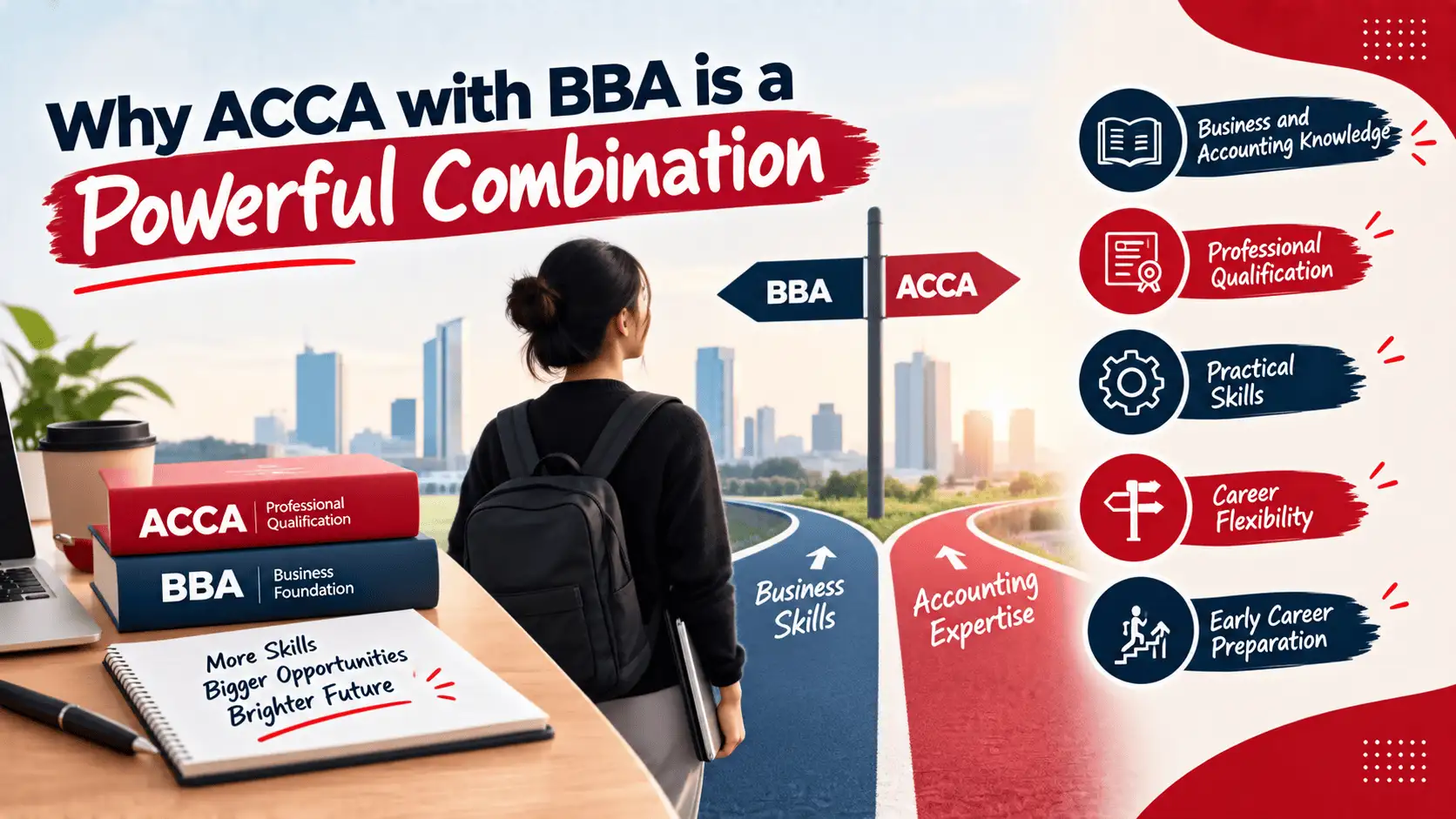
BBA and ACCA are related but different in their focus of business. BBA prepares you to understand businesses and their functioning, whereas, ACCA prepares you to handle accounting and finance decision making and accounting. By studying both of the programs, you will gain not only business knowledge but accountant professional skills as well. This combination can help you prepare for different roles in the business and finance sectors.
- Business and accounting knowledge: BBA equips you with business knowledge, whereas ACCA develops your knowledge of financial reporting, auditing, taxation and financial management.
- Professional qualification: There is the option to pursue a university course while developing the skills required for an internationally recognized accounting qualification.
- Practical skills: ACCA helps you apply accounting and finance knowledge to real business situations.3
- Career flexibility: Investigate career options in accounting, finance, auditing, and business skills.
- Early career preparation: Pursuing ACCA while at BBA helps to kick off your professional career early.
How to Start Your ACCA with BBA Journey
If you have finished your +2 or any equivalent course, you can now begin with the planning of BBA and ACCA at the same time. It’s a simple procedure, but certain requirements need to be considered before your enrollment. You may take both ACCA and BBA together and acquire the necessary skills that you will use in your coming profession by taking up ACCA along with your BBA. Here are some guidelines:
- Select a BBA college: You must choose a well-established college that has obtained a BBA degree with subjects of related accounting, business, and finance.
- Select your ACCA learning option: You can either study BBA and ACCA together through an integrated or coordinated program, or enroll in a regular BBA program and study ACCA separately through an ACCA learning provider.
- Check entry criteria for ACCA: Make sure that you meet the academic qualification criteria.
- Check for ACCA exemptions: There is a chance of exemption from ACCA exam on fulfilling certain criteria from BBA course subjects. You should always check your degree and university prior to planning your papers.
- Planning for study schedule: Plan for ACCA papers you would be able to prepare along with BBA classes and examinations.
- ACCA Registration: Do ACCA registration once you fulfill the requirements and start preparing for ACCA.
How to Prepare for ACCA Along with BBA
Studying both BBA and ACCA simultaneously can be easier if you have a clear plan in place for your studies. Both take regular preparation so concentrate on learning the material rather than relying solely on revision at exam time. Maintain notes that are well structured, monitor progress and focus on challenging areas. Having a consistent approach can make it easier to prepare for the ACCA alongside your BBA and not make it unnecessarily stressful.
- Set daily study targets: Divide larger subjects into smaller units, and complete each in succession.
- Frequently revise ACCA subjects: Periodical revisions will allow you to memorize vital concepts in a better way.
- Use quality study materials: Learn from books of study, revision, and practice that have a quality corresponding to the new syllabus of the ACCA.
- Study topics that are difficult for you: Try to find topics in which you often make mistakes and work on them.
- Learn from your mistakes: Analyze wrong answers and try to figure out why you have made a mistake rather than just reading the right answer.
- Keep yourself updated about ACCA: Stay informed about syllabus updates, exams format, and other vital news.
- Keep your routine in order: Proper use of your sleeping and resting time, during your school year will help you to concentrate on your studies.
Why BBA Students Choose ACCA Over CA
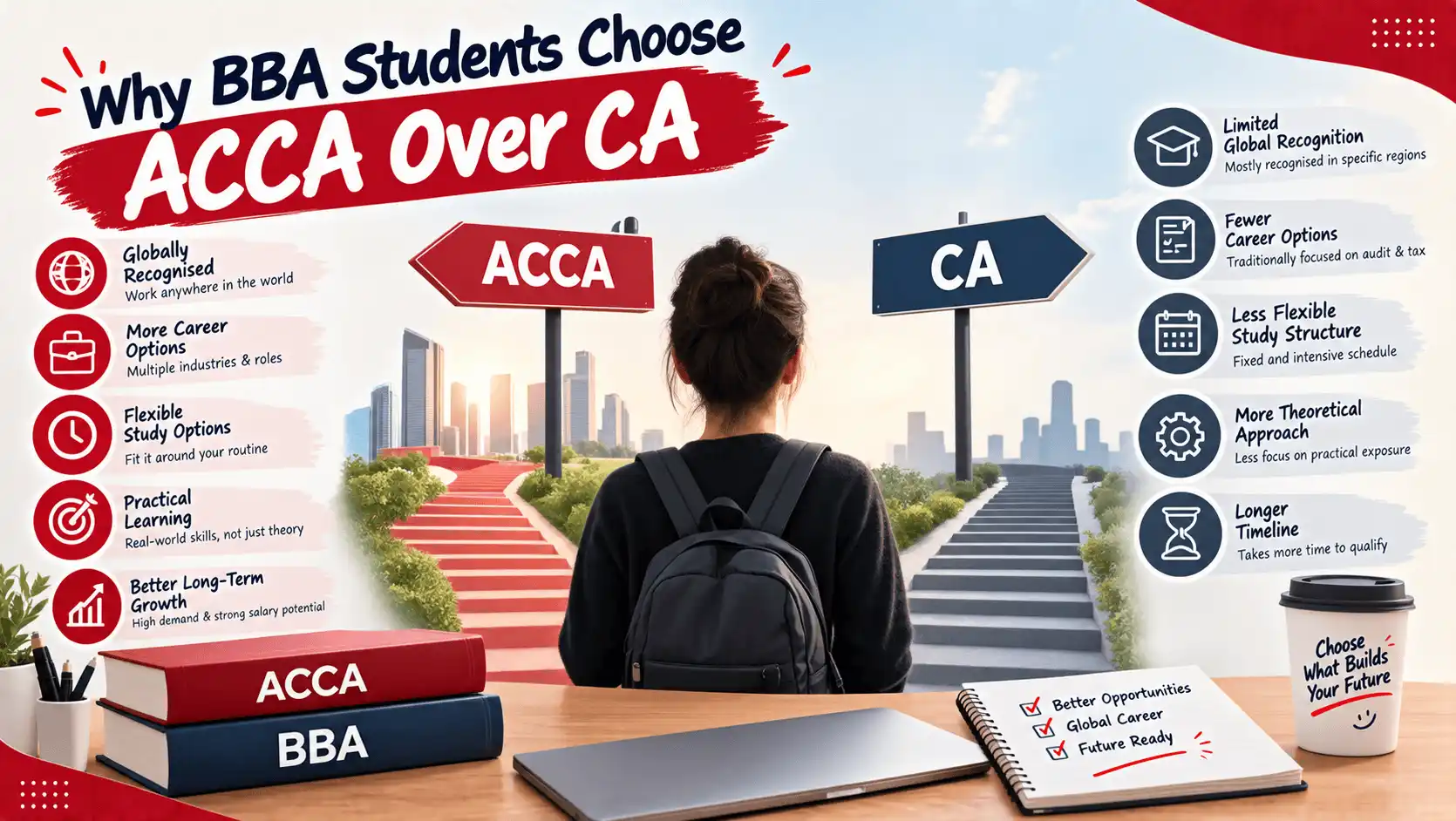
BBA students often compare ACCA and CA because both provide professional pathways in accounting and finance. However, they have different structures and requirements. ACCA is an international professional accountancy qualification, while students in Nepal can pursue Chartered Accountancy through the Institute of Chartered Accountants of Nepal (ICAN). ACCA also provides flexible study options, including full-time, part-time, online, and weekend learning, with exams offered through on-demand and scheduled sessions depending on the paper.
| ACCA | CA |
| International professional accountancy qualification | Professional accounting qualification offered by ICAN in Nepal |
| Covers accounting, financial reporting, taxation, audit, financial management, and related areas | Covers accounting, assurance, business and finance, law, taxation, and other professional areas |
| Offers flexible study and exam options | Follows the course structure and training requirements set by ICAN |
| Can support careers in accounting and finance across different countries, subject to local requirements | Provides a pathway to CA membership and professional practice in Nepal after meeting ICAN's requirements |
| Students may receive exemptions based on their previous qualifications | Entry and progression depend on ICAN's eligibility and course requirements |
Some BBA students may choose ACCA because they want a flexible professional qualification that can be studied alongside their degree. Others may consider CA because they want to follow Nepal's professional accounting pathway through ICAN. The better option depends on your preferred career direction, study requirements, budget, and whether you plan to work mainly in Nepal or explore opportunities internationally.
Benefits of ACCA with BBA
Studying ACCA with BBA can give you a mix of business knowledge and professional accounting skills. The two programs cover different areas, which can help you understand both the management and financial side of an organization. Along with academic qualifications, practical experience, communication skills, and technical abilities are important for building a successful career.
- Study both qualifications together: You can work toward a bachelor's degree while progressing through your ACCA qualification.
- Build business knowledge: BBA helps you understand management, economics, marketing, finance, and how businesses operate.
- Develop accounting skills: ACCA provides deeper knowledge of accounting, financial reporting, taxation, audit, and financial management.
- Explore different careers: The combination can open opportunities in accounting, finance, auditing, banking, business analysis, and management.
- Understand financial decisions: Knowledge from both programs can help you understand how financial information is used in business planning and decision-making.
- Gain practical exposure: Internships, projects, and entry-level work can help you apply what you learn in real business situations.
- Prepare for international opportunities: ACCA can provide an international professional qualification that may support finance and accounting careers in different countries, depending on local requirements.
Things to Consider Before Choosing This Combination
ACCA with BBA can offer a strong mix of business and accounting education, but it also requires commitment. Before choosing both programs, consider your study capacity, budget, interests, and long-term career plans. Considering these points beforehand can help you understand what BBA with ACCA involves and prepare for the commitment more effectively.
- Study workload: Consider whether you can manage BBA classes, assignments, exams, and ACCA preparation at the same time.
- Total cost: Plan for BBA tuition, ACCA registration and exam fees, learning materials, tuition classes, and other related expenses.
- Time commitment: Both programs require regular effort, so consider how much time you can dedicate to studying each week.
- Interest in accounting: ACCA includes subjects related to accounting, audit, taxation, and finance. Make sure you are comfortable studying these areas.
- Available exemptions: Exemptions vary according to your previous qualification and institution. Check your specific eligibility before planning your ACCA papers.
- Practical experience: Completing ACCA involves relevant practical experience and other requirements in addition to passing the exams.
- Career plans: Think about whether ACCA supports the type of career you want to pursue, particularly if your interests are in accounting, finance, or related fields.
Career Opportunities After BBA with ACCA
With knowledge of both business management and professional accounting, you can explore several areas of the finance and business sector. The role you pursue may depend on your qualifications, experience, skills, and career interests. You can explore opportunities in banks, accounting and audit firms, financial institutions, consulting companies, multinational companies, and other organizations. ACCA membership also requires relevant practical experience in addition to completing the required exams and other qualification requirements. Some common career options include:
- Accountant: Accountants maintain financial records, prepare financial reports, and support businesses with their financial activities.
- Financial Analyst: Financial analysts examine financial information, prepare reports, and help organizations understand their financial performance.
- Audit Associate: Audit associates review financial records and supporting documents and assist with audit procedures and reporting.
- Tax Associate: Tax associates work on tax calculations, documentation, returns, and compliance. Knowledge of Nepal's tax system can be useful when working locally.
- Management Accountant: Management accountants work with budgets, costs, financial reports, and business performance to support internal planning.
- Business and Finance Consultant: With relevant experience, you can work in advisory roles that involve analyzing financial information and helping organizations address business and financial issues.
Why Choose Seekshya Academy?
Choosing the best academy for ACCA and the right learning environment can make your preparation more organized, especially when you are studying BBA at the same time. Seekshya Academy provides classroom and online learning options, along with academic support and exam-focused preparation for ACCA students. For students planning to manage BBA and ACCA together, these learning and support options can help create a more structured study routine.
- Experienced faculty: Learn from experienced ACCA and CA-qualified tutors who explain complex topics in simple ways.
- Flexible learning options: Choose between classroom and online classes based on your schedule and learning preference.
- Recorded classes: Access recorded lessons through the learning system for revision or to catch up on missed classes.
- Regular mock tests: Practice through mock exams, assignments, and assessments to become familiar with the ACCA exam format.
- Personal support: Get guidance for difficult topics and academic questions during your ACCA preparation.
- Practical learning: Case-study-based teaching and additional training can help connect accounting concepts with real business situations.
- Internship and career support: Seekshya provides internship placement assistance and career guidance to help students gain practical exposure.
- Scholarships and rewards: Eligible students can access scholarship and performance-based reward opportunities.
- ACCA-approved learning provider: Seekshya Academy states that it is an ACCA Platinum Approved Learning Partner.
Conclusion
Studying BBA with ACCA can be a suitable option for students who want to build a career in accounting, finance, or business. BBA provides a foundation in business and management, while ACCA develops professional knowledge in accounting, taxation, auditing, and financial management. Studying both together can help you work toward a university degree and a professional qualification at the same time.
However, managing two programs requires commitment, time management, and proper planning. Before enrolling, check the course structure, fees, study schedule, and available ACCA exemptions. Choose a learning approach that fits your academic goals and allows you to prepare for exams without unnecessary pressure. With the right planning, you can make steady progress toward your qualifications and prepare for different career opportunities. If you want to learn more about accounting courses, professional qualifications, and career options, please check out our other blogs at Seekshya Academy.
Recommended Blogs:
- Is ACCA Equivalent to CA in Nepal? Full Comparison
- +2 Management with ACCA: A Smart Step to Success
- Top ACCA Jobs in Nepal: Career Scope & Salary In 2026
Frequently Asked Questions(FAQS)
1. Can I do BBA and ACCA together?
Yes, you can study BBA and ACCA together. Many students choose to pursue ACCA alongside their bachelor's degree. You can enroll in a coordinated program or study ACCA separately while attending your BBA classes. Make sure your study schedule allows enough time for both programs.
2. Which BBA is best for ACCA?
A BBA program with a focus on accounting and finance may be helpful for ACCA students. Subjects such as financial accounting, management accounting, taxation, and financial management can support your ACCA studies. You should also check whether the university's specific BBA program offers any ACCA exemptions.
3. How long does a BBA with ACCA course last?
A BBA program in Nepal commonly takes four years, while ACCA completion time varies based on exam progress, exemptions, and study pace. Some students complete ACCA exams during their BBA, while others continue afterward. ACCA membership also requires relevant practical experience and other qualification requirements.
4. Can we take ACCA after BBA?
Yes, you can pursue ACCA after completing your BBA. Depending on your university, degree, and subjects studied, you may be eligible for exemptions from some ACCA exams. Check the official ACCA Exemptions Calculator to confirm which exemptions apply to your qualification.
5. How many ACCA papers are exempted after BBA?
The number of ACCA exemptions after BBA depends on your university, degree, graduation year, and subjects studied. ACCA allows exemptions from up to nine Applied Knowledge and Applied Skills exams, but not all BBA graduates receive the same exemptions. Confirm your eligibility using the official ACCA Exemptions Calculator.