ACCA F8 Audit and Assurance in Nepal: Syllabus & Exam Guide
Audit and Assurance is an important paper in the ACCA qualification that introduces students to the principles and practices of auditing. It helps you understand how businesses prepare financial records and how auditors examine financial statements to check whether they are accurate and reliable. For students in Nepal, studying ACCA Previously known as F8, the paper is now officially called Audit and Assurance (AA) can help build a foundation for careers in auditing, accounting, financial reporting, and assurance services. It also develops skills that are useful in professional accounting roles.
Audit and Assurance (AA) and is part of the Applied Skills level of ACCA. The syllabus covers audit planning, risk assessment, internal controls, audit evidence, and auditor reporting. You will learn how auditors identify possible errors, assess business risks, and gather evidence before forming an opinion on financial statements. Whether you are preparing for your first attempt or planning to retake the exam - understanding the syllabus, exam format, and preparation methods can help you organise your studies and approach the exam with greater confidence.
What Is ACCA F8 Audit and Assurance?
ACCA F8 is the former name of the Audit and Assurance (AA) paper, which is part of the Applied Skills level. It introduces students to the audit process and explains how auditors examine financial statements, assess risks, collect evidence, and form an independent opinion. The paper helps students understand the purpose of audit and assurance engagements, the responsibilities of auditors, and the importance of following professional ethics and auditing standards.
Syllabus focuses on both technical knowledge and practical application. Students learn about audit planning, risk assessment, internal controls, audit procedures, and the preparation of audit reports. They also develop the skills needed to identify possible errors, evaluate business risks, and communicate audit findings clearly. The knowledge gained from this paper is useful for students interested in accounting and auditing careers. It also provides a foundation for Advanced Audit and Assurance (AAA), which students can study at the Strategic Professional level of ACCA.
Who Can Study ACCA F8 Audit and Assurance?
Audit and Assurance is an Applied Skills paper in the ACCA qualification. It is generally studied after completing the Applied Knowledge level or receiving relevant exemptions. Students from different academic backgrounds can study this paper, depending on their ACCA entry route and previous qualifications. A basic understanding of accounting can also make the subject easier to follow.
1. ACCA Students After +2
Students who have completed +2 or an equivalent qualification can begin ACCA if they meet the required entry criteria. They normally complete the Applied Knowledge papers before moving to the Applied Skills level, where Audit and Assurance is included.
2. Students With an Accounting Background
Students who have studied accounting may already understand financial statements, transactions, and basic accounting principles. This knowledge can be helpful when learning audit concepts. However, they still need to develop a clear understanding of audit procedures, evidence, risks, controls, and reporting.
3. Students With a Bachelor’s Degree
Graduates from accounting, finance, business, or related fields may be eligible for ACCA exemptions based on their previous qualifications. The exemptions available can vary depending on the degree, institution, and individual circumstances, so students should check their exemption status with ACCA.
4. Students Studying Financial Reporting
Students who have completed or are studying Financial Reporting can benefit from their understanding of financial statements and accounting treatments. This background can help when studying audit risks, assertions, audit procedures, and financial statement balances in Audit and Assurance.
5. Students Planning an Audit Career
Students interested in auditing, accounting, assurance, risk, or related finance roles can benefit from studying AA. The paper introduces practical audit concepts and helps develop skills that can be useful in professional accounting environments and future ACCA studies.
ACCA F8 Audit and Assurance Syllabus 2026–2027
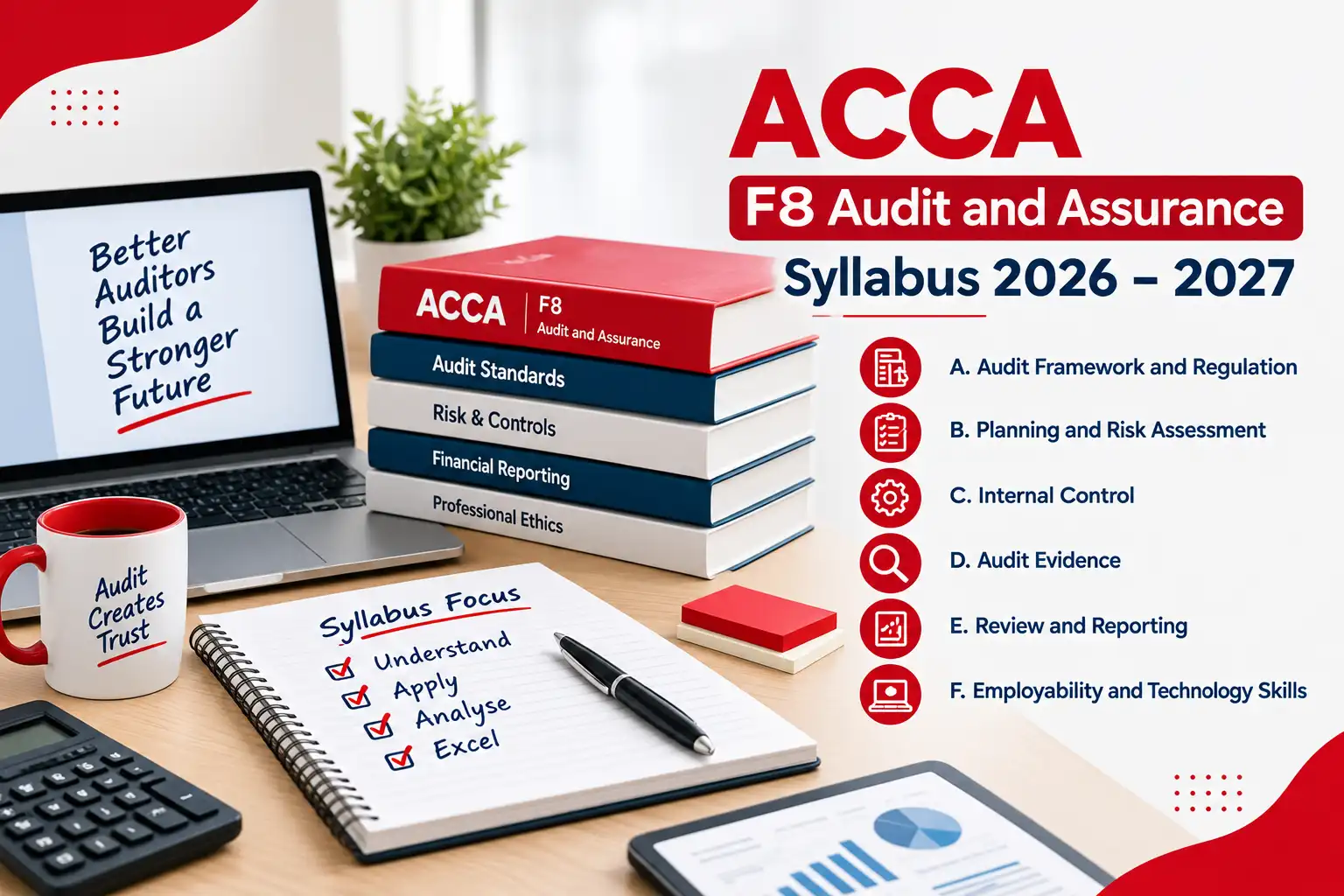
The syllabus develops an understanding of how auditors approach an engagement, assess financial statement risks, perform audit procedures, and reach a conclusion based on the evidence obtained. For the September 2026 to June 2027 exam period, the syllabus includes five main technical areas and a separate section covering employability and technology skills. Students should understand each area and practice applying the concepts to practical business situations.
A. Audit Framework and Regulation
Audit Framework and Regulation section covers the basic principles of audit and assurance, including their purpose, scope, and importance. It also explains the role and responsibilities of auditors, corporate governance, professional ethics, auditor independence, and relevant regulations. Students learn about internal and external audit, audit quality, critical and careful thinking, and the limitations of an audit. These concepts provide the foundation for understanding the other areas of the AA syllabus.
B. Planning and Risk Assessment
This area focuses on how auditors prepare for an audit before detailed testing begins. Students learn about accepting and continuing audit engagements, agreeing the terms of an engagement, understanding the client's business and environment, and identifying risks of material misstatement. The section also covers materiality, audit risk, fraud and error, audit strategy, audit planning, and appropriate responses to identified risks.
C. Internal Control
The Internal Control section focuses on the systems and procedures businesses use to manage risks, protect assets, and maintain reliable financial information. Students learn how to evaluate internal controls, identify weaknesses, explain their possible consequences, and recommend suitable improvements. The syllabus also covers tests of controls, computer-based controls, internal audit, and communicating control deficiencies to management and those charged with governance.
D. Audit Evidence
Audit evidence is the information auditors collect to support their conclusions and audit opinion. This section covers audit assertions, sources and types of evidence, audit procedures, sampling, tests of controls, and substantive procedures. Students also learn about auditing specific financial statement areas, using the work of internal auditors and experts, and applying technology or computer-assisted techniques during the audit process.
E. Review and Reporting
This section deals with the final stages of an audit and the preparation of the auditor's report. Students learn about going concern, subsequent events, written representations, final audit reviews, and the evaluation of audit evidence. It also covers unmodified and modified audit opinions, including qualified, adverse, and disclaimer opinions, as well as Emphasis of Matter and Other Matter paragraphs.
F. Employability and Technology Skills
Along with technical audit knowledge, students are expected to develop practical skills that can support their future accounting and auditing careers. This area focuses on using digital tools, working with computer-based exam formats, managing information, and presenting answers clearly. Students should also learn how to apply audit knowledge to practical business scenarios and communicate their findings in a clear and professional manner.
Important Topics in ACCA F8 Audit and Assurance
Students should prepare for the complete syllabus, but some topics need more practice than others. These areas often require you to apply your knowledge to a business situation. Understanding the basic concepts is important, but you should also practice writing clear and relevant answers. Regular question practice can help you improve your exam performance.
1. Audit Risk and Auditor's Response
Audit risk is an important topic in ACCA F8 Audit and Assurance. You need to identify risks from a business scenario and explain how they could affect the financial statements. Your answer should mention the issue, affected account or area, possible misstatement, and suitable action the auditor should take.
2. Audit Procedures
Audit procedures explain how auditors collect evidence during an audit. You should understand what the auditor will do, which document or information will be checked, and what the procedure is meant to confirm. For example, customer balances can be confirmed to check the existence of receivables.
3. Internal Control Weaknesses
You should be able to identify weaknesses in a company's internal controls and explain their possible effects. You may also need to suggest improvements. Common areas include purchases, sales, inventory, payroll, cash handling, and IT systems, so practice questions covering different business processes.
4. Audit Evidence and Assertions
Assertions help auditors check whether financial statement information is properly recorded. For example, existence checks whether an asset or liability is actually present, while completeness checks whether all required transactions and balances have been recorded. Practice matching suitable audit procedures with different assertions.
5. Audit Reports and Opinions
You need to understand how audit findings affect the auditor's report. This includes knowing the difference between an unmodified opinion and modified opinions, such as qualified, adverse, and disclaimer opinions. You should also understand when an Emphasis of Matter paragraph may be included.
How Difficult Is ACCA F8 Audit and Assurance?
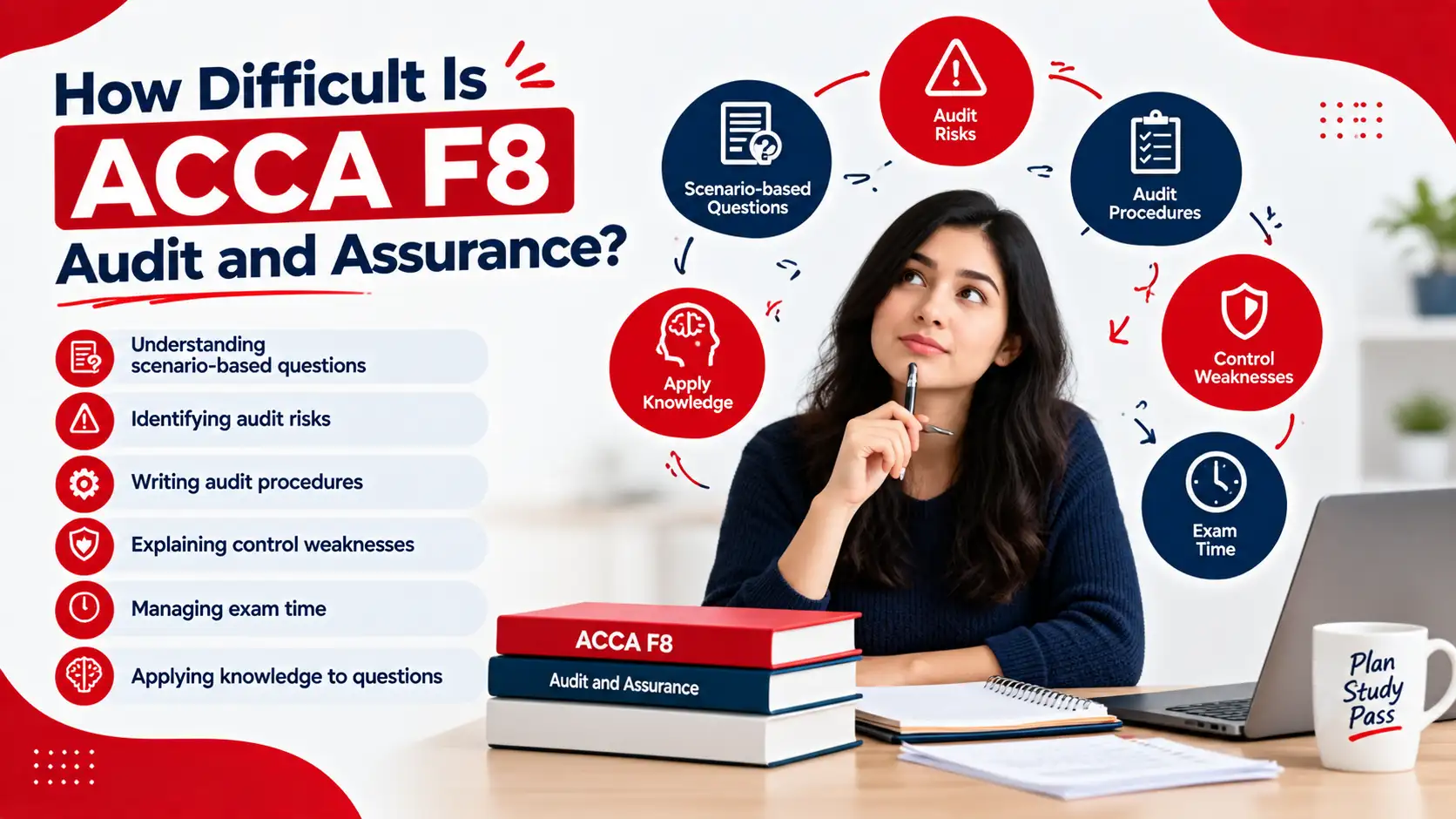
ACCA F8/ Audit and Assurance can be challenging because the exam focuses on applying audit knowledge rather than simply memorizing definitions. Students need to understand business scenarios, identify relevant issues, and explain their answers clearly. A basic accounting background can be helpful, but students still need to develop specific auditing skills. Regular practice is important for becoming familiar with the question style and improving answer writing.
1. Understanding scenario-based questions
Audit and Assurance questions often provide a business situation that you need to analyze carefully. Understanding what the question is asking and picking out the relevant information can take practice, especially when the scenario contains a lot of details.
2. Identifying audit risks
Students need to identify the actual risk from the information given rather than simply repeating details from the scenario. They should also explain how the risk could affect the financial statements and what the auditor should do about it.
3. Writing audit procedures
Audit procedures need to be specific and relevant to the issue being tested. Students may find it difficult to explain exactly what the auditor should check, which evidence should be used, and what the procedure is intended to confirm.
4. Explaining control weaknesses
Questions may ask students to identify weaknesses in internal controls and suggest suitable improvements. The challenge is to explain the problem clearly, describe its possible consequences, and provide a practical recommendation rather than giving a general answer.
5. Managing exam time
ACCA F8 Audit and Assurance includes both objective test questions and longer written questions. Students need to manage their time carefully so they can attempt every question. Practicing past questions under timed conditions can help improve speed and answer structure.
6. Applying knowledge to questions
Knowing audit concepts is only one part of the exam. Students also need to apply those concepts to different business situations. Reviewing examiner feedback and practicing questions can help you understand how marks are awarded and improve the quality of your answers.
Why Choose Seekshya Academy?
Choosing the best academy for ACCA can make your preparation more organized and easier to manage. Seekshya Academy provides ACCA classes with experienced tutors, regular practice, recorded lessons, and student support. The academy also offers online and classroom learning options. These facilities can help students build their understanding of AA and prepare for the exam with regular practice.
- Experienced Faculty: Learn from experienced ACCA and CA-qualified tutors who explain audit concepts in simple terms and help students understand how to apply them to exam questions.
- Practical and Case-Based Learning: Audit and Assurance requires students to apply their knowledge to business situations. Seekshya uses case studies and practical examples to help students understand audit concepts and their application.
- Regular Mock Tests and Assignments: Regular tests, mock exams, and day-to-day assignments give students opportunities to practice questions, improve their answer writing, and become familiar with the computer-based exam format.
- Recorded Classes and LMS: Students can access recorded lessons and learning resources through the Seekshya Learning Management System. This allows them to revisit difficult topics and revise lessons when needed.
- Flexible Learning Options: Students can choose between online and classroom classes. Seekshya also provides ACCA learning across different locations in Nepal, making it easier for students to choose an option that suits their needs.
Conclusion
ACCA Audit and Assurance (AA) is an important paper for students who want to build a career in accounting, auditing, and finance. The syllabus covers key areas such as audit planning, risk assessment, internal controls, audit evidence, audit procedures, and reporting. Since the exam focuses on applying knowledge to business situations, understanding the concepts and practicing different types of questions are both important. Students should also become familiar with the exam format and learn how to present clear and relevant answers.
Preparing for AA becomes easier when you follow a regular study routine and give enough time to question practice. Working through past questions, reviewing your mistakes, and practicing under time limits can help you improve your approach to the exam. Whether you are studying independently or taking classes, focus on understanding how audit concepts work in practical situations. For more useful information and resources, please go through our other ACCA blogs as well.
Recommended Blogs:
- ACCA FM Exam Guide 2026: Fees, Structure & Tips
- How Long Does It Take to Complete ACCA? | Duration Guide
Frequently Asked Questions
1. Is F8 ACCA difficult?
ACCA F8, now known as Audit and Assurance (AA), can be challenging because it requires students to apply auditing concepts to practical scenarios. Memorizing definitions alone may not be enough. With a clear understanding of the syllabus, regular question practice, and proper time management, you can prepare effectively.
2. What topics are covered in the ACCA F8?
The ACCA F8 syllabus covers audit framework and regulation, planning and risk assessment, internal control, audit evidence, and review and reporting. Students also learn about professional ethics, audit procedures, materiality, audit risks, and different types of audit opinions.
3. What is the format of the ACCA F8 exam?
The ACCA F8 exam is a three-hour computer-based exam carrying 100 marks. It includes 30 marks of objective test questions in Section A and 70 marks of constructed response questions in Section B. Students need at least 50 marks to pass.
4. How to pass the ACCA F8 exam?
To pass ACCA F8, focus on understanding audit concepts rather than memorizing answers. Study the complete syllabus, practice past exam questions, and improve your audit risk and procedure writing skills. Attempt timed mock exams and review your mistakes to identify areas that need more practice.
5. What are some common past papers for the ACCA F8 exam?
Students can practice past exam questions, specimen exams, and mock exams available through ACCA resources. Common practice areas include audit risk, internal controls, audit procedures, and audit reporting. Use the ACCA Practice Platform and examiner resources to become familiar with question styles and exam requirements.